
The signing appointment cannot be moved
A property chain, a mortgage offer with the clock running, parties who have travelled a long way, someone appearing by video conference: every one of them has already moved their diary once.
Mortgage approved, removals booked, a seller who has travelled a long way, sometimes a party appearing remotely: the signing appointment tolerates no outage. We operate the link that carries it — and it never leaves with a single path.
On completion day, several diaries have already moved once: the mortgage offer is running, the removals are booked, the seller has travelled a long way. What stops then is not an IT service — it is a commitment made by people who are not on your payroll.
A property chain, a mortgage offer with the clock running, parties who have travelled a long way, someone appearing by video conference: every one of them has already moved their diary once.
Identity documents, bank statements, movements of funds: a practice concentrates exactly what fraud hunts for everywhere else. The email that changes bank details at the last minute is known to the whole profession.
Land registry, banks, town halls, fellow notaries, clients sending their documents from a phone: some of these exchanges still go through a fax machine, on a line whose cut-off date is already set.
The socket at the table, the handset and the video conferencing bar are wired, prioritised and acceptance-tested before the first appointment.
It is the only question that matters, and we do not answer it with a promise. Every connection leaves with its 4G/5G mobile relay: our build standard, not a box ticked on a quote. At installation, we unplug the fibre in front of you. And we put in writing what the backup does not cover: a power cut with no UPS, an area with no usable mobile coverage.
There are two closures, not one. Since 31 January 2026, a line that fails can no longer be replaced like for like. The technical closure arrives batch by batch, town by town: we check the date for the practice and for the branch office alike.
What stops with the line is not just the telephone: the fax machine, of which notaries are among the last regular users; the remote alarm monitoring transmitter, often linked to the monitoring centre over copper; the lift emergency telephone, because a practice is open to the public. Equipment that appears to work is not proof: we run a real test before anything is cut off.
No copper offer sold in France any more.
Lines stop working in these towns.
After that, there is no more copper.
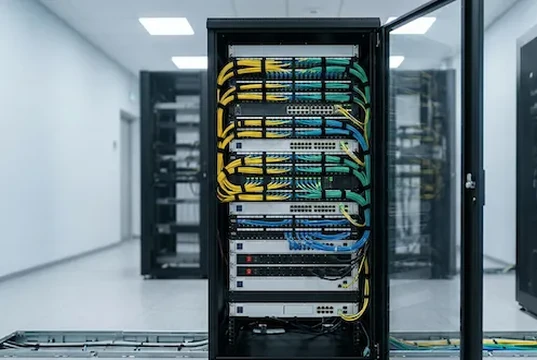
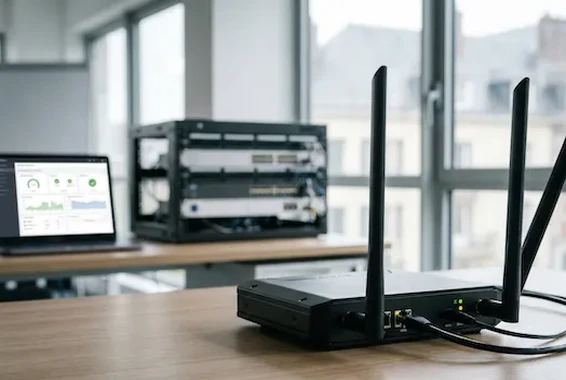
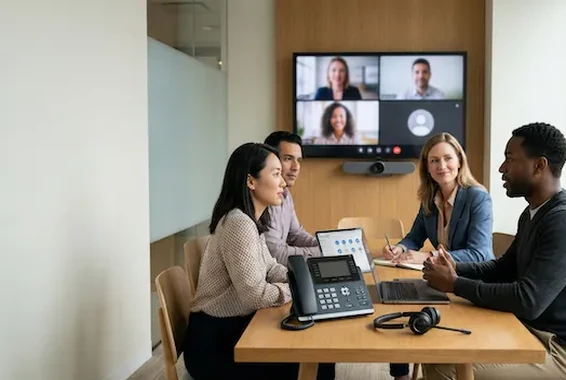
Fibre connection under our own operator identifier, hosted switchboard, number portability for your direct lines, rooms fitted with handsets and video conferencing bars.
Our telecoms divisionSegregation of uses, a visitor network kept apart from the practice’s own, encrypted remote access, data hosted in France and segregated by client.
Protect the practiceOut-of-hours reception, sorting incoming requests. One task to start with, bounded in writing, and someone on your team approves every action.
What we build in AIThe practice’s website, an up-to-date business listing, local visibility, and an app when a website is no longer enough.
Our digital divisionIt holds the critical uses; it does not reproduce a fibre connection. A controlled degraded mode, not a clone. That is why we measure the mobile coverage on site, at the exact spot where the antenna will go, before selling: if it is not good enough, we say so and we look for another route.
No. Both sites share the same switchboard and the same segregation rules, under centralised monitoring. A transfer between the practice and the branch becomes a two-digit call.
No, and it would be a bad idea. A written inventory first: every line, every number, every connected device, site by site. Then the batch and the availability check, the replacement plan, the switchover and the tests. The old line is cancelled last: no day without a phone.
Send us your telecoms invoices and the list of your addresses. We will tell you what is still on copper, which batch each site belongs to, and what is still plugged into an analogue line without anyone remembering it.
A visit on site, an inventory of the lines and equipment still connected to copper, and a written switchover plan.