Skip to content
Sector — Care homes and social care facilities

At night, everything rests on one call that has to get through.

Nurse call, night warden alarm, the lift emergency telephone, the on-call rota: every one of them runs over a line or a network. The day one of the two gives way, it stops being an IT incident.

  • Arcep operator identifier: SKBS
  • 4G/5G relay as standard
  • Proactive 24/7 monitoring
What travels through your building

This is not office IT.
These are safety-critical systems.

A nurse call, a lone worker alarm, a lift emergency telephone: all of it runs over a line or over your network. And at three in the morning, nobody can go and check why it no longer gets through.

Day-to-day life in the home

What a home actually lives through,
and what no catalogue describes.

A night team that cannot be everywhere

A handful of staff, several floors, residents calling. The nurse call and the lone worker alarm leave no room for approximation.

Care happens at the bedside, not at a desk

Treatment trolley, handover tablet, remote consultation in the bedroom. You have to cover bedrooms, corridors, the lift shaft and the garden — inside old walls that were never built to let radio waves through.

Three audiences, one cable

Care staff, residents and their families, providers connecting remotely. The day an inspection asks who has access to what, the answer has to be in writing.
What it looks like in your business

Four answers,
in the order of your three constraints.

  • A connection with two paths. Your link is operated under our own identifier, and every connection leaves with its 4G/5G relay. Not a box to tick on the quote: it is how we build a link.
  • Coverage surveyed room by room. Right into the lift shaft and out to the garden, with cabling and rack handled in the same job. We measure, we do not assume.
  • Networks that cannot see one another. Care, administration, families, providers, telephony, CCTV: each on its own segment. Your software publishers’ remote access goes through an encrypted tunnel, never through a port left open on the internet.
  • A switchboard that follows the care staff. Numbers kept, overflow to the on-call rota in the evenings and at weekends, DECT handsets for the floors.
What we deploy in a property FTTH fibreFTTO fibre4G/5G relay Bedroom WiFiIP CentrexSIP trunk DECT on the floorsSegregated networks
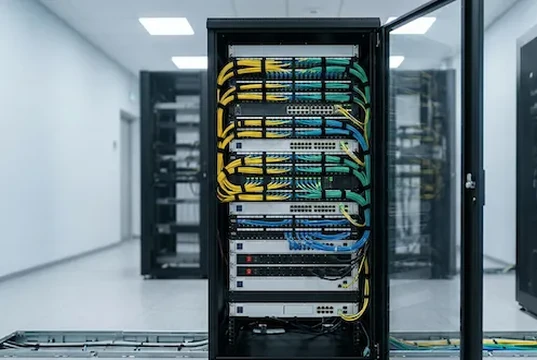
Fibre patch rack and network equipment in a technical cabinet
The first objection we hear

“And if it goes down on a weekend night,
when there is nobody here?”

Our monitoring is continuous: we see the incident, often before you call, and the 4G/5G relay switches over on its own. That said, we will not promise the impossible: no network runs without power. Hence the UPS, which we quote for every time, with its expected runtime. What is covered, and what is not, is written down before signature — not discovered on the night of the incident.

31 January 2026

National commercial closure

No copper offer sold in France any more.

3
31 January 2027

Technical closure of batch 3

Lines stop working in these towns.

4
2028 — 2029

Batches 4, 5 and 6 — town by town

7
November 2030

Batch 7 — the end

After that, there is no more copper.

Your lines have a switch-off date

It is already set,
town by town.

Two closures, not one: the commercial one has already passed, the technical ones arrive batch by batch. Your address belongs to one of them — we check its date for each of your sites.

What nobody thinks of: the lift emergency telephone — calling the emergency services from inside the car is a regulatory obligation; the lone worker alarm that protects your night warden; the door entry system at the entrance; the fax machine still used with the pharmacy. A device that appears to work is not proof: before anything is switched off, we run a real test.
On the ground

What we install, and what we operate.

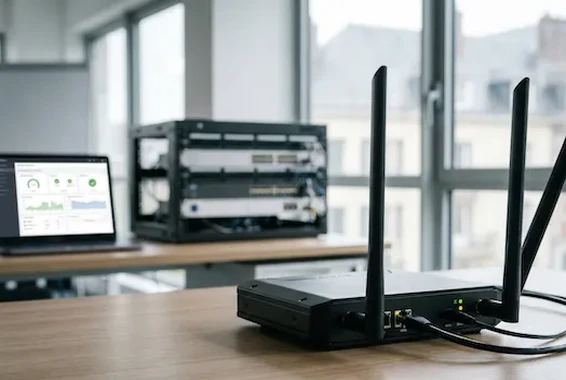
Professional router with mobile backup access
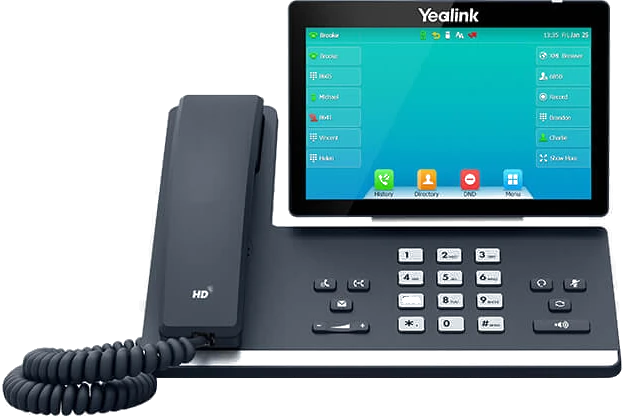
IP handset with a touchscreen
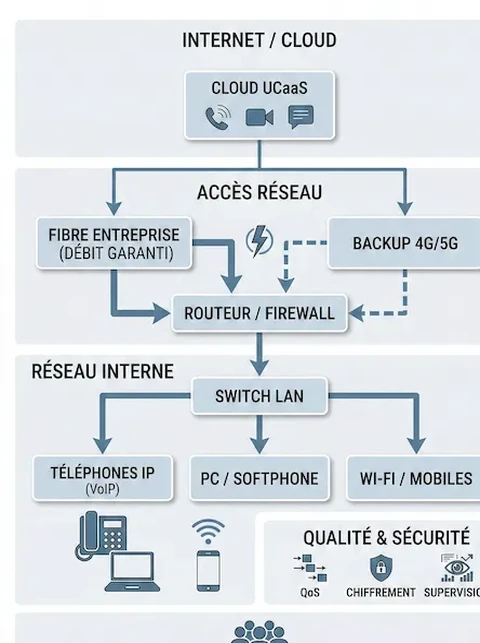
Telecoms architecture diagram for a business site

What we carry

  • The FTTH or FTTO connection, of which we are the operator, and its 4G/5G relay
  • The local network, the cabling and the rack, labelled and documented
  • WiFi in the bedrooms, the corridors and the communal areas
  • Telephony, your numbers kept, and continuous monitoring

What stays at your premises

  • The resident record and the care software — your choice, your publisher. We carry the network they live on.
  • The nurse call system — that is the trade of whoever installed it. We host it on a sealed segment and we test whatever still runs over a line.
  • Exit control on the secure unit — same rule.
  • The home’s strategic plan — there, we will be of no help whatsoever.
50 + experts: telecoms and network engineers and technicians, developers, graphic designers
200 + projects delivered, from the telecoms link to the AI agent
100 % of data hosted in France, with no offshore subcontracting
24/7 proactive monitoring of your links and your network
Managers’ questions

What we are asked on site visits

Do we have to close a wing to have the work done?

No. You do not empty a care home to pull cables. We work zone by zone, to your timetable, and the old network stays in service until the zone has been signed off.

What happens when the link goes down in a care home?

The 4G/5G relay takes over on its own, on every connection we deliver: it is how we build, not an option. The return to fibre is just as automatic. A call in progress may be cut off and have to be redialled straight away: we would rather write it down.

We already have a lift company and a nurse call installer. Are you replacing them?

No. We coordinate them: we list what is still connected to copper and we test every replacement before anything is switched off. One point of contact for the switchover, not one more provider.

Let us take the tour
of your establishment

Have the switch-off date of your lines checked, building by building, along with everything still plugged into them. The assessment is free and ends in writing: what stops, when, and what takes its place.

Call Free assessment