
Four providers, nobody accountable.
The cost of the split appears on no invoice. It is in the hours spent getting people to talk to one another who have no reason to talk to one another.
Published on 4 August 2026 · 5 min read · by the SkyNet technical team
Friday, 12:04. The switchboard has stopped ringing and the payment terminal is refusing cards. The dining room is full.
Three calls later, you have three answers. The operator sees its link green (the link: the connection that joins your site to the outside world). The managed service provider sees its servers up (the managed service provider: the company that manages your computers and your servers). The publisher of the till software sees its services responding normally.
Nobody is lying. Each one looks at their own piece, and their piece is fine.
The ticket travels.
The outage does not move.
- Each provider tests its own scope — and finds it healthy, because it is.
- The fault is at the boundary — between two domains, where no contract stops or starts.
- Nobody sees both sides — so nobody can settle it. It is not ill will, it is geometry.
- The only one who sees the whole picture is you — and you are not a technician.
The line goes down
The operator
“The link is green at our end.”
The managed service provider
“Our machines are responding. It is coming from the network.”
The publisher
“Our servers are up. It’s at your end.”
Back to the operator
A new adviser. We start again from the beginning.
The cause
A filtering rule changed the day before on the firewall, on the IT side, closing a port used by the telephony. Two domains. One single cause.
The firewall: the device that filters what comes in and out of your network. A port: the numbered “door” through which two pieces of software talk to each other.
The split does not create
incompetent people.
It creates blind spots, and it creates them by design.
- A contract describes a scope. That is its job: to say where responsibility begins and where it ends.
- A provider is judged, paid and renewed on that scope. Never on the neighbour’s.
- So the space between two scopes belongs to no one. Yet that is where most long-running outages live.
- And to settle it, you have to see both sides at the same moment. None of the four can.

It is not on the invoice.
It is in your diary.
Add up the four subscriptions: you do not get the cost of the split. You get the price of the services. The cost itself appears on no line.
First, it is in the hours of the one who coordinates. In an SME, it is neither a technician nor a project manager: it is the director, or the person who handles the admin. The most expensive person in the room, taken up with the least skilled work there is — repeating to B what A has just said.
It is then in the delay. Being handed on does not cost five minutes: it costs a round trip. A call back, someone’s availability, sometimes a slot the next day. Three hand-offs turn a one-hour outage into a lost day.
It is finally in the projects that never get started. Opening a second site, changing the switchboard, connecting the till to the booking software: all of that means getting people to talk to one another who have no reason to. So it gets put off. Nobody decides to give up; it simply gets put off.
We have no figure to sell you on that, and we will not invent one. But you can measure it at your own premises. For one month, for each incident, note three things: the date, the number of times you had to chase someone, and who ended up resolving it. After a month, the total is yours. It is the only figure worth anything.
We sell the one-stop shop.
Here are its three flaws.
Written by us. An article that hands out weapons against its own model is the only one you can believe.
You depend on a single provider
If it is bad, it is bad everywhere at once. And the day you leave, you leave on everything at once.
You put less out to tender
Four separate lines are easy to compare. A single bundled price, far less so. Insist on the detail item by item, not a round figure.
Nobody is excellent at four disciplines by accident
Ask who, by name, holds each building block — and what is subcontracted. The answer always exists.
These three flaws have the same remedy, and it comes down to three written requirements: reversibility (what you get back if you leave), ownership (your data and your domain names are in your name) and access (you hold the administrator credentials for your own equipment).
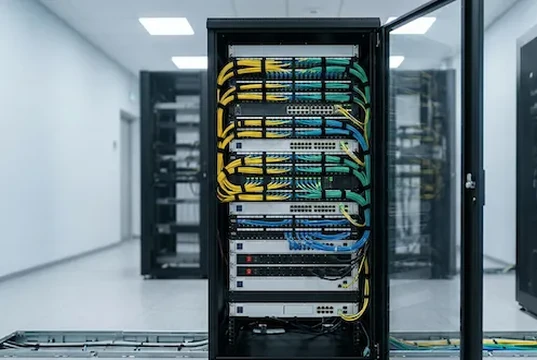
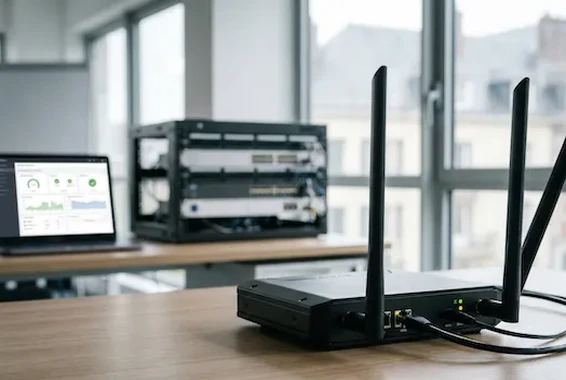
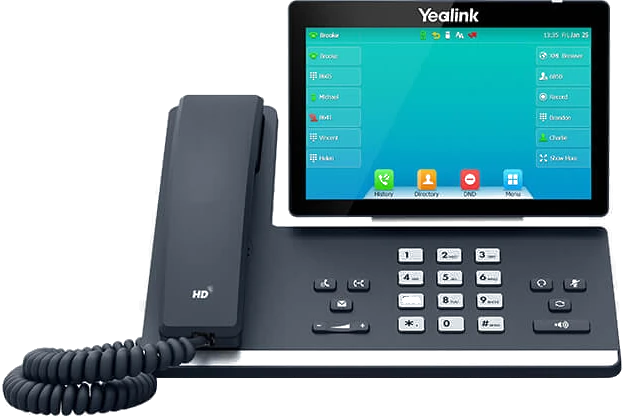
The link, the network, the workstation: the same team.
A good provider
answers without hesitating.
The five questions that follow fit on a business card. Put them to us as well as to the others: it is the answers that sort them out, not the brochures.
Five questions
before signing.
1. If the fault sits at the boundary between two domains, who opens the ticket and sees it through to the end?
Expect a name, not a department. “Support” is nobody’s commitment.
2. Are my domain names and my administrator accounts registered in MY name?
Have it shown to you on screen, in a meeting. The domain name — your site’s address — registered in the provider’s name is the most common lock, and the most painful one to break.
3. If I leave, what do you give me back, in what format, in how many days?
That clause is called reversibility. If it is not written into the contract, it does not exist.
4. Who answers the phone on a Friday at 12:04? And at 22:00?
Ask for the hours in writing, and what happens outside them. A verbal promise of availability is worth nothing on a public holiday.
5. Of these disciplines, which do you subcontract?
The right answer is not “none”. The right answer is precise: what is handled in-house, what is not, and who answers in that case.
What we do not do. We do not replace your accountant, your business software or your advertising agency. We hold the link, the network, security, the AI agents and the web — and we operate your links under our own Arcep operator identifier: SKBS. When a project falls outside that scope, it is written in the proposal, with the name of whoever takes it on.
What to remember
- When four providers pass the ball to one another, none of them is lying: each one sees its own piece, and its piece is fine.
- The outages that drag on live between the scopes — a space that no contract covers.
- The cost is not on the invoice: it is in the director’s hours, in the delays, and in the projects pushed back.
- The one-stop shop creates a real dependency. The remedy is written down before signing: reversibility, ownership of the data, administrator access.
Send us your contracts. We will tell you where the holes are.
Your telecoms, IT and web contracts side by side: we show you in writing what nobody covers today, and what covering it would cost. It is a status review, not a quote in disguise.