
The switchboard moves to the cloud.
It is not what breaks.
Replacing a telephone switchboard with a hosted service takes one morning. What derails a migration is the porting of the numbers and the devices plugged into the phone line that do not look like phones.
Published on 4 August 2026 · 6 min read · by the SkyNet technical team
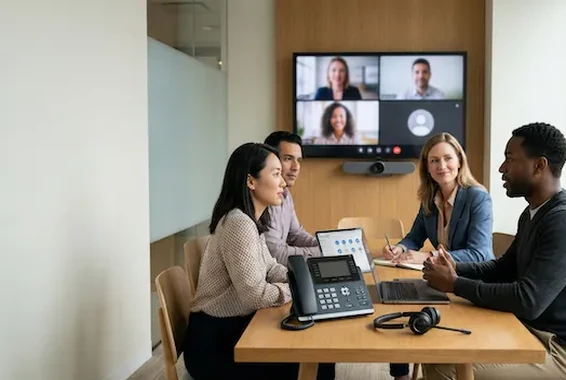 The switchboard, the visible side
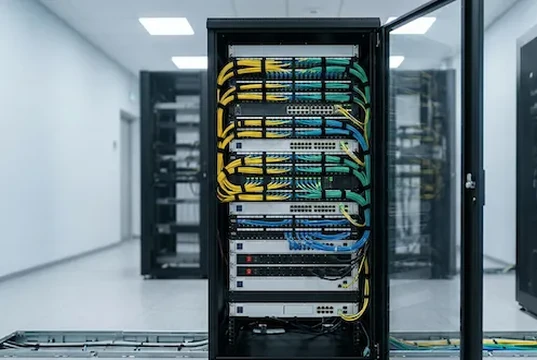 And on the comms room side
Friday, 12:04. The switchover was done the previous evening, everything was working. A guest is stuck in the lift and presses the alarm button. The unit dials its number, as it has done since it was installed. Nobody answers: its line was cancelled along with the switchboard. The lift maintenance company will call back on Monday.
Three concrete things,
from the very next day.
The phone follows the person
The same number rings on the desk phone, on the mobile and in the browser.
Reception sorts itself out
Opening times, message, on-call diversion: a web page, no longer a meeting.
One more site in a day
The handset ships preconfigured. You plug it into the network and it registers itself.
It is never the phone.
It is what was plugged in next to it.
A migration is prepared by following the cables, not by counting the handsets.
The devices
that never ring.
They are forgotten because they are silent. Nobody uses them, so nobody declares them.
Three answers exist, and they are not equivalent: replace the device with an IP or mobile model, connect it through an ATA (an adapter — a box that recreates a telephone socket from the computer network), or keep a dedicated line when the manufacturer has nothing else.
What we do not promise: that your fax machine moves onto IP. The fax was designed for an analogue line; over IP, the transmission remains sensitive. We test before cutting. If it does not go through, the way out is the digital fax, not a miracle setting.
A lift emergency phone cannot be checked on paper. You press the button in the car, and someone answers at the call centre. Until that test has been passed, the migration is not finished.
No more box.
But nothing at all without the link.
A hosted switchboard lives at the end of your internet connection. That is the only reason we install a mobile backup wherever the telephone carries the turnover.
Number portability is a right.
It is not a button.
Numbers are resources allocated to operators by Arcep, then assigned to their customers. number portability (taking your numbers to another operator) is the mechanism that lets you keep them. Five things to know before you sign.
- A mandate signed by you authorises the new operator to act with the old one. Without it, nothing moves.
- The file has to be accurate to the character : line identifier (the RIO, the operator identity statement), company name, address. A single discrepancy with the outgoing operator’s file gets the request rejected. It is the leading cause of postponement we see.
- A block of direct numbers is ported as a whole. Keeping half of it on one side is not an ordinary option.
- Porting the main number terminates the installation that carried it. No going back the next morning.
- The porting date is confirmed in writing, and it is never the date of your order.
How long? We do not publish a typical lead time : it depends on the outgoing operator, on how clean the file is and on the number of blocks. What we do give is the date as soon as it is confirmed — and nothing is unplugged before it.
Five moments,
in this order.
The day before
Handsets installed and tested. The old switchboard is still working.
Early in the morning
The number port switches over. Inbound calls arrive on the new installation.
Within the hour
Inbound, outbound, direct dial numbers, diverts, hunt groups — tested from outside, never from the office.
Third parties
Lift, alarm, payment terminal: triggered for real, with the provider on the line.
The old link
Terminated afterwards. Never before.
The morning.
Never on a Friday evening.
In the morning, your teams report what is wrong and the third parties answer: the lift company, the alarm monitoring provider, the payment provider (the company behind the card terminal). On a Friday at 18:00, nobody answers before Monday, and a twenty-minute fault takes up the whole weekend. We do not schedule a switchover on a Friday afternoon: that is a rule, not a diary preference.
What we install, and what we operate.
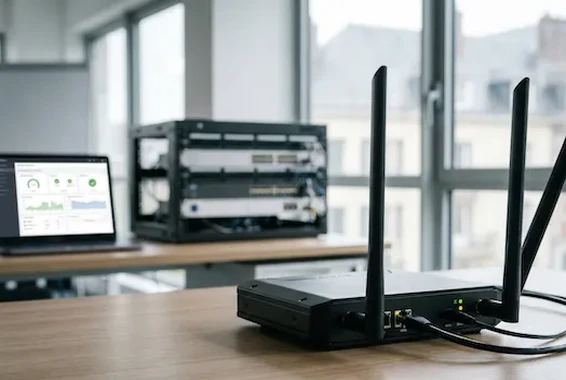
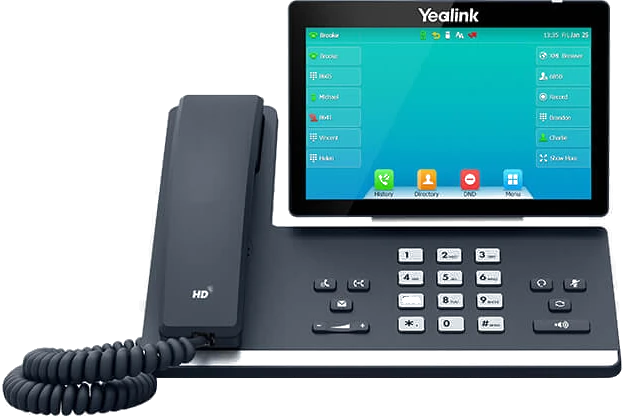
Two jobs,
or just one.
The commercial closure of copper is behind us: since 31 January 2026, no offer is sold on this network any more. The technical closure arrives batch by batch — 31 January 2027 for batch 3, 2028 to 2029 for batches 4, 5 and 6, November 2030 for the last one.
Migrating your switchboard without dealing with the analogue lines around it means opening the same job twice. The detailed timetable is here.
What makes the price,
is the inventory.
A quote drawn up without having followed the cables is not a price: it is an estimate that gets corrected along the way.
To be listed
before any quote.
- The number of handsets actually in use — not the number of employees.
- Every number: main, direct, blocks, reception, fax, and the ones no longer in use but still printed somewhere.
- Every analogue line and whatever is at the end of it. Follow the cable.
- The diversions and on-call rules in place, even those set up by someone who has since left.
- The type of link at each site, and whether there is a backup.
- On-site cordless phones (DECT) and their base stations: the cost that is always discovered too late.
Five questions
to ask before signing.
To us as much as to anyone else. A vague answer is information in itself.
- Who calls the lift maintenance company and the alarm monitoring company — you, or me? Write it into the proposal.
- If porting is postponed by the outgoing operator, who pays for both subscriptions in the meantime?
- If the link goes down, where do inbound calls go, and after how many seconds?
- Are the handsets locked to your platform? If I leave in three years, do I take them with me?
- On switchover day, who answers, and on what number?
We work with Accor and Logis Hôtels hotels. They trust us.
What to remember
- The easy part is the switchboard. What breaks is the silent analogue devices and the porting date.
- You trade a rare hardware failure for a permanent dependency on the link: hence the mobile backup wherever the telephone carries the turnover.
- Porting the main number terminates the original installation. With no going back.
- We switch over in the morning, we test from outside, we trigger the third parties for real, and we cancel the old link only at the very end.
Send us your invoices.
We give you back the inventory.
Your telecoms invoices and the list of your addresses are enough. We send back what is still analogue, what is connected at the far end, and in what order to deal with the sites. A written review, not a quote in disguise.