
The end of copper: it is not your phone, it is your lift
The same timeline, told through what it cuts off: the lift car, the alarm transmission, the payment terminal.
Read the article on the equipment that gets cut offYour line still works. But the date of its final cut-off is already written. Here are the real deadlines, the equipment that will stop with it, and the steps to follow.
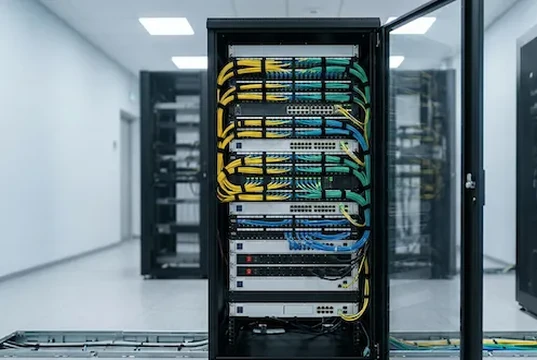 Fibre — the replacement
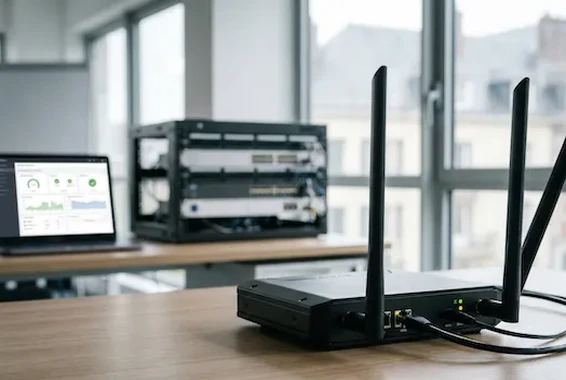 4G/5G relay
Since 31 January 2026, no offer on copper is sold any more. A line that breaks down can no longer be reordered.
The signal is cut off for good, batch by batch, town by town, between 31 January 2027 and November 2030.
We display only officially established deadlines. Your address belongs to a batch: we check its date for each of your sites.
The lines genuinely stop working in those towns.
Last batch. After that, there is no more copper.
The question is no longer “should we migrate?”, but “on what date, and with what plan?”
They do not look like telephones, but they will stop with the line.
No more alert transmission — and often, no more insurance cover.
Regulatory obligation: calling the emergency services must remain possible.
A terminal on a telephone socket stops authorising transactions.
The link to the monitoring centre often runs over copper.
The badge still works; the emergency call does not.
Entry panels on the switched network have to be replaced.
Healthcare, notaries, industry: the analogue fax does not survive.
Protection of people: this upgrade cannot wait.
A piece of equipment that “seems” to work is not proof. Before cutting the old line, we trigger a real test: transmission to the monitoring centre, a call from the lift car, a transaction on the terminal.
Fibre, dedicated connections, mobile backup, switchboard in the cloud. What takes time is the inventory and the coordination of third parties.
Three checks, which you can do yourself in half an hour.

Every line, every number, every connected device, site by site. Written down.
The closure date for each address.
One solution per use, with a budget and a date.
Connections ordered, handsets configured at our premises, numbers ported.
We test before cutting. The old line is terminated last.
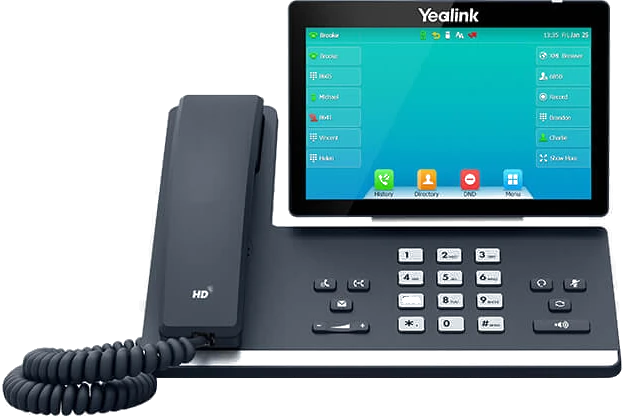
Copper is a medium, not your telephone identity. Your numbers are kept through number portability, without changing a digit.
We work with Accor and Logis Hôtels hotels. They trust us.
Explore our switchboard in the cloud
A site can lose copper before it is connected to fibre. A 4G/5G mobile connection then takes over, and your numbers keep ringing.
We are both operator and integrator: the entire migration is handled by the same team.
Our services rely on ISO 27001 and HDS certified data centres, located in France.
Yes. They are kept through number portability and transferred without changing a single digit: main number, direct numbers and blocks of numbers.
Very probably. Alarms, alarm monitoring, lift emergency phones, payment terminals, gates, door entry systems, fax machines and lone worker alarms often run over an analogue line. Each one needs a solution tested before the line is cut.
Several weeks: inventory, ordering the connections, number portability, tests. The limiting factor is rarely the telephony, it is the third-party providers. Planning a year ahead is nothing excessive.
Often the opposite. Analogue lines are billed individually and it is not unusual to find several that are no longer used. We price what exists and what we propose side by side, with no commitment.
The same timeline, told through what it cuts off: the lift car, the alarm transmission, the payment terminal.
Read the article on the equipment that gets cut offWhat takes the place of your lines, and why the failure almost always comes from the local network rather than from the switchboard.
Read the article on the switchboard in the cloudSend us your telecoms invoices and the list of your addresses. We tell you which lines are still on copper, which batch each site belongs to and what leaving costs. It is a status review, not a quote in disguise.