
The end of copper: it is not your phone, it is your lift.
Find your date, then draw up the list of what stops with the line. The telephone is the easy part.
Published on 4 August 2026 · 5 min read · by the SkyNet technical team
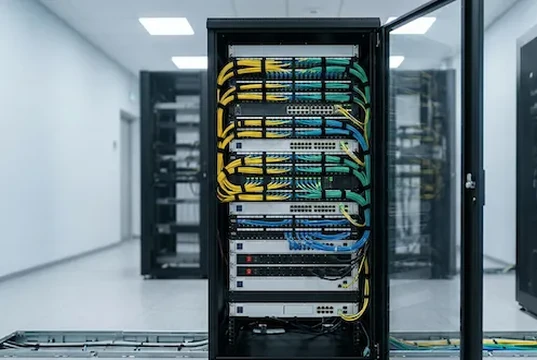 What takes its place
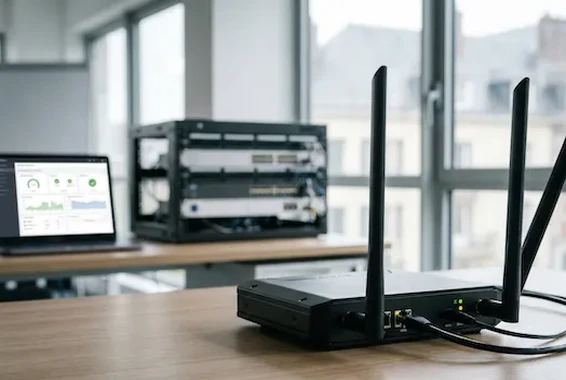
The grey box that nobody opens
In the plant room of your lift there is a grey box. Inside: a modem, and a pair of copper wires running out to the street. That is the path taken by the call from the alarm button in the car.
The day that pair stops working, the button will still light up. The speaker will still crackle. And nobody will answer any more.
That is why the end of copper is badly named. Everyone thinks of the telephones: they are the only visible devices. The real issue is elsewhere — the lift, the alarm, the backup payment terminal, the gate. They talk over the same line, and nobody has counted them.
Your date is not 2030.
It is your town’s.
Copper is not switched off all at once. It is switched off in batches, and each of your sites belongs to a batch.
Two closures,
only one that cuts.
The commercial closure is behind us. Since 31 January 2026, no offer on copper has been sold. It is not a cut-off: it is a closed door. An analogue line (a conventional telephone line, over two copper wires) that breaks down can no longer be reordered.
The technical closure, on the other hand, really does cut the signal, in batches of towns.
The split is public, address by address, at the infrastructure operator that runs the copper network. So a multi-site group does not have one date: it has as many as it has towns.
End of new Numeris connections
National commercial closure
Technical closure of batch 3
The signal is cut off in these towns.
Batches 4, 5 and 6
Batch 7 — the end
After that, there is no more copper.
The inventory
that nobody does.
These devices do not look like telephones. They plug into a telephone socket all the same, and they will stop on the same day.
The simplest physical clue: a T-socket behind a device, or a flat two-wire cable. The accounting clue: on your invoices, the wordings « ligne analogique », « RTC », « T0 » or « T2 ».
Each of these devices has a replacement, and it already exists. The table below says which one, and above all who has to act — because it is almost never your operator alone.
What speaks through the copper line, and what takes its place.
| The equipment | What stops | The replacement, and by whom |
|---|---|---|
| Lift emergency telephone | The voice link between the lift car and an emergency service — it is required by regulation. | Mobile transmitter with its own SIM card, or IP unit with battery backup. Reconfigured and tested by your lift maintenance company. |
| Alarm panel and remote alarm monitoring | The transmission of alerts to the alarm monitoring centre. | IP transmitter doubled with a mobile path. Re-read your insurance contract: it sometimes requires a specific means of transmission. |
| Backup payment terminal | The bank authorisations of the terminal plugged into a telephone socket, the one that gets brought out when the main one goes down. | IP or 4G terminal, ordered from your payment provider (the company that handles your card takings). |
| Gate, barrier, door entry system | The visitor call and the emergency call. The badge, meanwhile, carries on working: that is what misleads. | Built-in mobile call module, or IP entry panel connected to the building network. Access control installer. |
| Safe alarm relay | The alert sent through to the bank or the monitoring centre. | A dedicated IP link, defined with the organisation concerned — it is they who set the accepted protocol. |
| Fax machine | Sending and receiving faxes. Still alive and well in healthcare, in the legal profession and in industry. | Digital fax: the document arrives by email, and the number stays the same. |
What we do not do. We do not re-certify a lift or an alarm installation: that is a matter for your lift maintenance company and your installer. Nor do we know how many analogue lines are asleep in your estate — nobody knows before the inventory. What we do: find them, call those providers, and test before cutting.
It is not the fibre
that sets your timetable.
They are the lift maintenance company, the alarm monitoring company and the payment terminal provider. Each has its own schedule, and you are not its only client.
Twelve months before your date, and here is why.
Porting your numbers and delivering preconfigured handsets is counted in weeks. The rest is a matter of coordination. The plan is read backwards, starting from the cut-over.
- Months 12 to 10 — the written inventory. Every line, every number, every device plugged into it, site by site.
- Months 10 to 8 — the third parties’ quotes. This is the moment when you discover that a lift transmitter cannot be replaced the following week.
- Months 8 to 4 — ordering the connections. A fibre connection can require civil engineering works (digging, pulling a cable): it is the most unpredictable item of the job.
- Months 4 to 2 — the switchover and number portability (the transfer of your numbers to the new operator, without changing a single digit).
- Month 2 to 0 — the real tests, then the termination. You make a call from the lift car, you set off an alarm, you put a transaction through. The old line goes last, never first.
Starting six weeks before the deadline means accepting that your timetable will be set by the first available provider.
The replacement already exists. It is the inventory that is missing.

Five questions to ask — of us as of anyone else.
- Which batch does each of my addresses belong to, and on exactly what date?
- Can I have the written list of my analogue lines, site by site, including those that are no longer used but are still billed?
- Who contacts my lift maintenance company, my alarm monitoring company and my payment terminal provider: you, or me?
- Which real tests will be run before the cut-off, and who signs the report?
- What happens if the fibre is not connected in time at one site?
The third question is the one that sorts them out. A provider who answers “we’ll see when the time comes” will leave you coordinating four companies on your own, on a Friday.
We operate your links under our own Arcep operator identifier: SKBS. We work with Accor and Logis Hôtels hotels. They trust us.
What to remember
- The of sales closure took place: 31 January 2026. The technical, the one that cuts the signal, runs from 31 January 2027 (batch 3) to November 2030 (batch 7).
- Your date is not a national one. It depends on the town of each site.
- The risk is not the telephone: it is the lift emergency phone, the alarm, the backup payment terminal, the gate and the fax.
- The lead time is set by the third parties, not by the operator. Twelve months is nothing excessive.
- We test before cutting over. The old line is cancelled last.
Have the inventory drawn up, not a quote
Send us your telecoms invoices and the list of your addresses. We give you back the closure batch for each site, the list of lines still on copper and what is plugged into them. It is a written review, and it commits you to nothing.