
A hotel’s WiFi is judged at the third minute.
Nobody measures a speed in a room. What is measured is the time between putting down the suitcase and the series starting.
Published on 4 August 2026 · 6 min read · by the SkyNet technical team
Room 214, 23:10
The suitcase is down. The phone comes out of the pocket. From there, three things can go wrong — and none of them is about speed.
Finding the network
Four names appear, inherited from three successive installations. The guest picks one at random, and it is the wrong one. A hotel needs only one name, from the lobby to the top floor.
Getting through the portal
The login portal (the page that opens to accept the terms) asks for the name, the room, the date of birth. Every unnecessary field is a chance to give up.
Getting the picture
The connection is established, but the video spins on nothing. Nothing is broken: the signal is too weak at the far end of the corridor to hold a stream.
The guest who lost three minutes will not say so at reception. They will write it somewhere else, the next day.
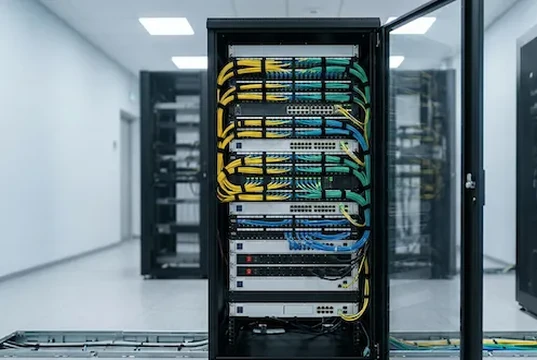
The speed arrives in the basement.
The rest is corridor work.
Increasing the subscription of a hotel whose WiFi does not get through the walls changes nothing: you widen the pipe coming in, not the one going up. Complaints that “the WiFi is slow” are settled between the comms room and the bedroom.
One access point per floor,
is an access point for nobody.
The calculation is not done by the square metre. It is done on what the walls let through, and on the number of devices switched on at the same time.
Fast radio waves travel badly through stone and concrete: an access point placed in the corridor serves the nearby rooms well, the one at the far end far less so. Add a metal fire door, a mirror, a services duct, and the coverage map no longer looks like the floor plan.
Second point, invisible on a quote: theroaming (automatically moving from one access point to the next as you walk). A phone stays attached to its access point for as long as it can. If it lets go between the lift and the room, the call drops. This is not fixed by adding power: you take power away, and you multiply the access points.
The till and the lounge
do not share a network.
It is the cheapest measure in a hotel, and it costs nothing more when it is planned in from the design stage.
On a flat network, a guest’s laptop and the booking software are next-door neighbours. Yet the same cabling can carry sealed-off networks: guests, staff, till, cameras, televisions, lift. Each with its own rules.
One setting almost always slips through the net:isolation of guests from one another. Without it, the tablet in room 214 can see the one in 216. It is a tick box, not a budget.
Every field you ask for is data to protect.
The portal is the only place where your WiFi collects anything. So it is the only place where it exposes you.
- Ask only for what is useful. The GDPR sets out the principle of minimisation: you do not collect “just in case”. A date of birth to open a WiFi connection cannot be justified.
- Keep the connection and the newsletter separate. Making the connection conditional on a marketing sign-up, or pre-ticking the box, does not produce valid consent.
- Write down the duration. How long the data is kept, by whom, and what happens next. If nobody can answer, it is because nobody has decided.
- Cater for devices with no browser. A television, a games console or an e-reader do not display the portal. They need a dedicated access path, decided at the design stage — not improvised on a Sunday.
- What we will not decide. Whether a hotel falls under the retention obligations laid down for access providers is a legal question. We are not lawyers: we configure what your adviser has decided, and we write it down.
A plain portal is crossed without a thought. That is all we ask of it.
What we look at, and what you should ask us
Coverage cannot be deduced from a plan. It is measured on site, device in hand, room by room.
What we survey on site
- The real materials: stone, concrete, fire doors, mirrors.
- The existing cabling, its length and the state of the sockets.
- What already lives on the network: till, cameras, televisions, lift.
- The number of devices per room on a full-occupancy evening.
- The conference room, where everyone connects in the same minute.
The five questions to ask
- How many access points, and based on which survey? Show me the measurement.
- How is the staff network separated from the guest network?
- What happens when I walk from the lift to the room?
- Who sees the outage first: you, or my receptionist?
- What does the portal collect, for how long, and who has access to it?
What we do not promise. No guaranteed speed room by room: what is committed to is the link that enters the hotel — which we operate under our own identifier — and the architecture that distributes it. And our in-room app TellMiz does not yet connect to hotel software: so we do not sell it.
We work with Accor and Logis Hôtels hotels. They trust us.
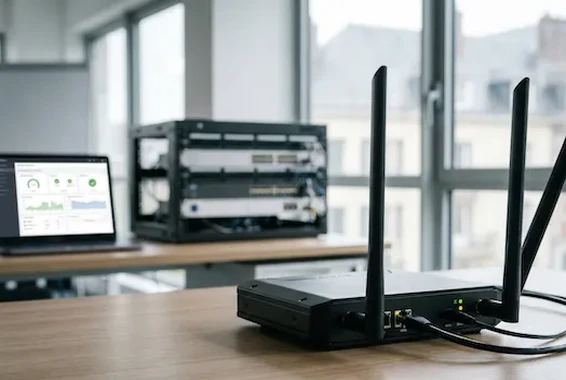
What holds up a hotel’s WiFi

What to remember
- A guest judges three minutes, not a speed: finding the network, getting through the portal, getting the picture.
- A single network name, from the lobby to the top floor.
- The number of access points comes from an on-site survey, not from a floor area — and we lower the power so that the call does not drop in the corridor.
- The guest network and the hotel network never see each other, and guests cannot see one another.
- The portal asks only for what is useful, states how long it keeps it, and caters for devices with no browser.
Let’s get your most difficult floor measured
A room-by-room survey, a costed coverage plan, and a written answer to the only question that matters: how long between the suitcase and the first image?