
The switchboard moves to the cloud. It is not what breaks.
What derails a migration is almost never the switchboard: it is the porting of the numbers and the analogue handsets nobody had listed.
Read the article on migrating a switchboardA hosted switchboard, reachable from a desk phone, a computer or a mobile. You keep your numbers. You lose the cabinet in the comms room.
The PBX in the plant room dates from before you arrived, and the company that installed it no longer exists. The smallest change requires a site visit.
Nobody knows how many calls ring out unanswered. And a customer who gets no answer does not call back: they call somewhere else.
Three branches, three operators, three renewal dates. Nobody knows what the telephony really costs.
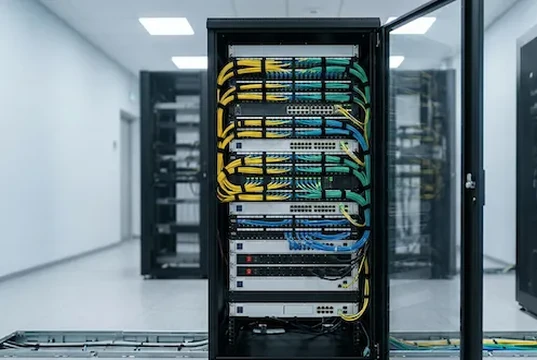
An email two seconds late bothers nobody; a conversation that breaks up is unusable. We do not subcontract the transport. Our services rely on ISO 27001 and HDS certified data centres located in France.
The switchboard is hosted in a data centre rather than in your comms room. Your telephones connect to it over the internet: nothing left to maintain, and adding a handset becomes a setting.
Your switchboard stays in place, connected to our network over the internet instead of copper. The right choice when the installation is recent, compatible and not yet written off.
How we decide: an old switchboard, or one incapable of speaking IP, and Centrex is more economical from the first year; a recent, compatible switchboard, and the SIP trunk extends its life. We decide on your actual hardware, not on a catalogue.
Your number is on your cards, your vehicles and in your customers’ phones.
What we carry
Greeting message, menu options, hunt groups by department. The right person answers first time.
Opening hours, public holidays, overflow to a mobile in the evening. No more endless ringing.
A single internal numbering plan, whatever the number of addresses. A transfer between branches becomes a two-digit call.
Calls received, missed, waiting time, distribution by hour. You see where it jams before the customer tells you.
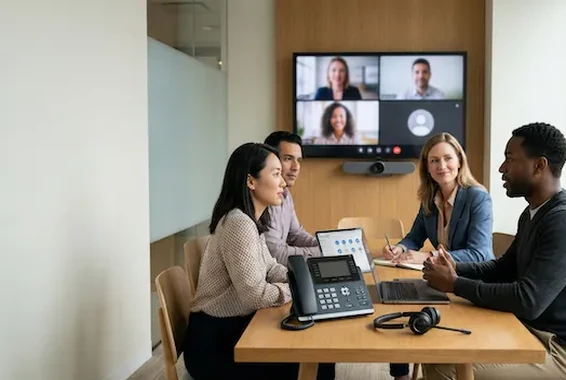
A branch, a building site, a train, home: the line follows the person. A single number presented from any device, simultaneous ringing on the desk phone and the mobile, transfer in mid-conversation — and the private number is never presented to your customers.
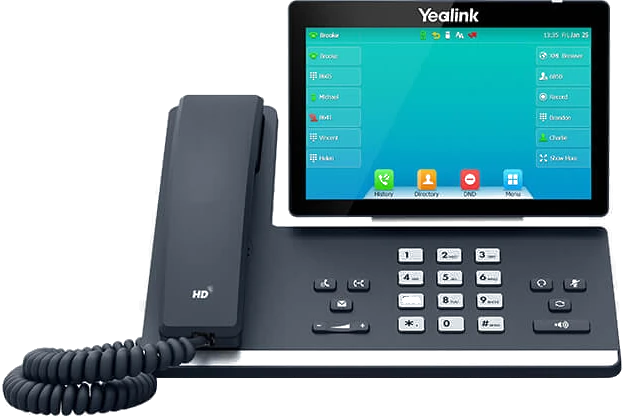
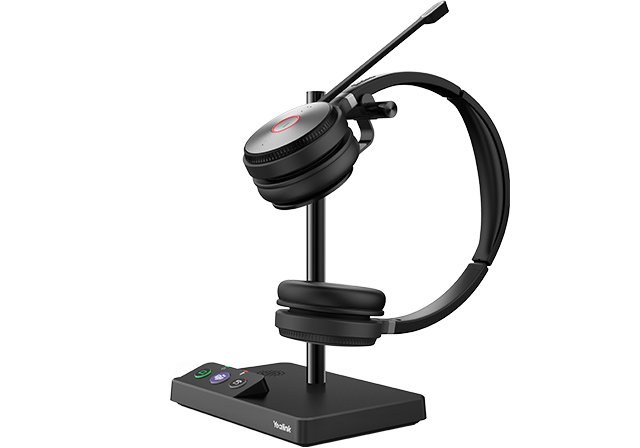
We deploy Yealink solutions. Every handset is prepared before it ships: the line, the name, the keys.
From the workshop phone to the reception phone with a colour screen. DECT cordless handsets, video-conferencing bars, Webex integration. Hands-on training on site.
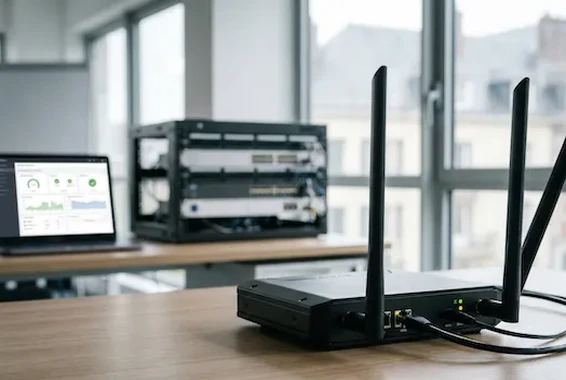
The local network matters as much as the handset. An IP phone needs a port that powers it over the cable and a segmented network. We deploy Omada by TP-Link and handle the cabling in the same project. See Network & WiFi.
We count the people to reach, not the offices.
Who rings, in what order, at what times.
They are the ones who set the date: they follow a regulatory notice period.
Configured, named and tested before they arrive on site.
We are on site, the numbers arrive, we train the teams.
The national commercial closure of the copper network took place on 31 January 2026, and the technical closures continue batch by batch until November 2030. Your alarms, lifts, door entry systems and payment terminals are affected just as much as your phones.
No. Your numbers belong to you: we take them over through number portability, transferred to our network on an agreed date, without changing a single digit — the main number as well as the direct lines.
Not necessarily: the hosted switchboard uses your existing connection, and we first check that it can carry the expected number of simultaneous calls. We recommend 4G or 5G backup: without it, a fibre cut also cuts the phones.
With a link backed up by 4G or 5G, calls switch over to the mobile network. Without backup, incoming calls are diverted to designated mobiles or to an announcement, according to rules defined in advance.
It depends on the model: recent IP handsets can often be reused after reconfiguration, analogue ones and old PBXs cannot. We take the inventory before proposing anything at all — if equipment can be kept, we keep it.
A few days to configure the switchboard. It is the number porting that sets the real timetable: it follows a statutory notice period that cannot be shortened. A firm date as soon as the file is accepted.
In-room phones, automatic wake-up calls, room status, link with the front-desk software: a configuration we handle regularly.
We work with Accor and Logis Hôtels hotels. They trust us.
You will find the detail on the page for Hospitality.
What derails a migration is almost never the switchboard: it is the porting of the numbers and the analogue handsets nobody had listed.
Read the article on migrating a switchboardThe batch-by-batch timetable through to 2030, and the list of equipment that still speaks over the telephone line.
Read the article on the copper timeline
Number of handsets, number of sites, equipment in place: twenty minutes is enough. You leave with a clear status review, whether you work with us or not.