
Shared or dedicated fibre: speed is not the question.
The figure in the leaflet commits nobody. What protects you fits into two lines of contract: what is guaranteed, and how long it takes to get you back on your feet.
- Arcep operator identifier: SKBS
- 24/7 monitoring of your links
Published on 4 August 2026 · 5 min read · by the SkyNet technical team
 The link
 What goes up
Sharing a capacity,
or reserving it.
Friday, 12:04. The sales director’s video call starts breaking up. Nobody has changed anything. The speed written on the invoice has not moved by a single megabit.
A fibre shared shares the capacity of the network between several subscribers. The advertised speed is a maximum, not a reservation. When the neighbours back up, download or stream, that maximum is shared.
A fibre that is dedicated reserves a capacity that belongs to you alone. It is symmetrical: the upload speed (what leaves your premises) is equal to the download speed (what arrives).
The contention ratio — how many subscribers share the same capacity — is almost never published. It is the first question to ask. The answer fits into one sentence, or it does not exist.
Speed can be negotiated.
The restoration time cannot.
A speed that is too tight is felt. A cut link stops dead. It is the second outage that decides the contract, not the first line of the leaflet.
The GTR, the line nobody reads.
The GTR — the guaranteed restoration time — is the maximum time, written into the contract, between an outage being logged and the service coming back. It deserves four readings, not one.
- It does not promise the absence of outages. It promises a response time. That is not the same sentence, and it is not the same job.
- The clock starts when the ticket is opened, not at the moment of the cut. A Friday-evening outage that nobody detects costs you the whole weekend before the guarantee starts to run.
- “Business hours” is not “24/7”. The same figure is not worth the same thing depending on the wording that follows it.
- Compensation is counted in days of subscription, not in lost turnover. The contract gives you back the subscription; it does not give you back the day.
So monitoring matters more than the figure. A short guarantee that starts on Monday morning is worth less than a long guarantee triggered by an alert at 2:00. We run our links under our own operator identifier (Arcep: SKBS): the incident appears on our monitoring, and the ticket opens without you calling.
What goes up matters just as much
as what comes down.
As long as you are only browsing, the asymmetry does not show. As soon as you send, it shows immediately.
Video-conferencing
Your picture leaves from your premises. A meeting with six people is six upload streams.
The backup
An off-site backup uploads. If it spills over into the working day, it takes the place of work.
What you host
A server, a till or a booking engine accessed from outside: all their traffic is upload.
A shaky video call
is not a screen problem.
It is almost always the upload speed that is missing, or a neighbour filling the shared pipe at the same moment. The handset and the camera have nothing to do with it.
Which use justifies what.
| Your situation | Shared | Dedicated |
|---|---|---|
| Web, email, a switchboard in the cloud | Enough | Not needed |
| Daily video conferencing with the outside world | At off-peak times | Stable |
| Server, till or booking system hosted at your premises | No | Yes |
| Off-site backup every night | Overflows | Yes |
| An hour of downtime costs more than the annual subscription | No | Yes |
| Several sites linked together | No | Yes |
When shared fibre is enough — and it often is.
A four-person practice that reads its email, browses and makes calls has no need for dedicated fibre. Selling one to them would be easy, and dishonest.
Shared fibre does the job and costs considerably less. The budget saved pays for 4G/5G mobile backup better than for a speed nobody will use.
The switch does not depend on the size of the company. It comes down to three signals: you host something that the outside world consults, your business stops dead when the link goes down, or your upstream flows have become a daily matter.
Five questions to ask — of us as of anyone else
- What is the GTR, in hours, and does it cover nights and weekends?
- Does the clock start when I report it, or when you detect it?
- Who is watching my link at 3 in the morning, and what do they do if it goes down?
- Is the upload speed guaranteed, or only “up to”?
- If the GTR is not met, what happens — and on which page is that written?
What we do not know. We do not publish an average availability rate: we have no independent measurement to show you, and a figure that cannot be proved is worth nothing. On a link that we run, however, we produce the record for yours.
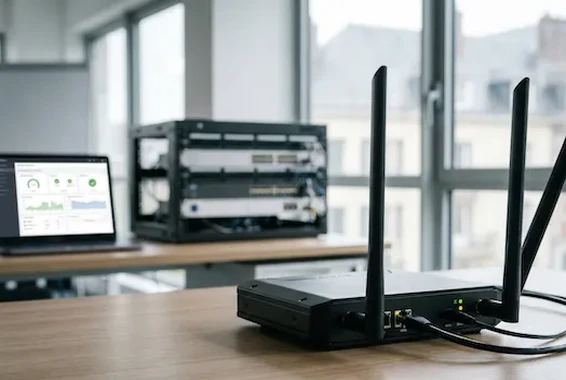
No fibre survives
a digger.
Shared or dedicated, a single link remains a single point of failure. A mobile connection that takes over on its own often costs less than the gap between the two offers.
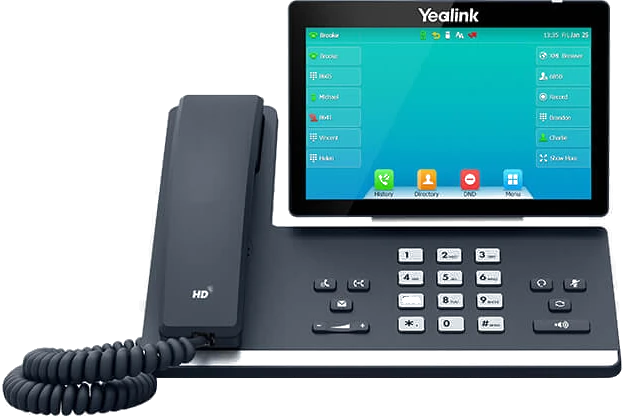
What we install, and what we operate.
What to remember
- Shared fibre shares the capacity; the dedicated one reserves, and in both directions.
- The advertised speed is a maximum. The only figure that commits anyone is the one written as guaranteed.
- The guaranteed restoration time starts when the ticket is opened: without monitoring, the best guarantee in the world starts too late.
- As soon as you host, back up or run video calls, it is the upload speed that decides, not the download.
- Shared fibre is enough for many uses. The real trigger is what an hour of downtime costs.
Have your contract read
before signing another one
Send us your current access contract and the addresses of your sites. We tell you what is guaranteed, what is not, and whether moving to dedicated fibre is justified in your case. Sometimes the answer is no.